


Do I need or want an advocate?
Whether you think you do, whether you're unsure, whether you've already decided, then you're right. Maybe you also don't need one. Whatever your choice in the end, its always best to find somebody who could help and provide additional advocacy support.
BuddyHub has categorised Advocacy support into 5 levels to help you determine what level of support you're looking to engage.



SELF ADVOCACY
When you want to speak for yourself and just need more information, like right now.
Examples:
-
understanding rights;
-
preparing questions;
-
writing down concerns;
-
preparing for a meeting;
-
understanding a Service Agreement;
-
learning how to complain.
QIDAN describes self-advocacy as speaking up for your own rights and needs

INFORMAL / CITIZEN ADVOCACY
You get a trusted person or community member to help you express your wishes
This type of advocacy may include:
-
family member;
-
friend;
-
trusted community member;
-
citizen advocate.
Citizen advocacy is a recognised advocacy model where a community member develops an advocacy relationship with a person with disability.
Importantly, an informal supporter is not automatically an independent advocate and is not automatically authorised to receive private information or make decisions.
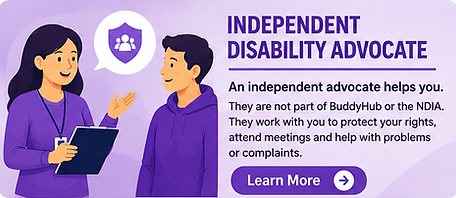
INDEPENDENT DISABILITY ADVOCATE
An independent NDAP-funded advocate to represent you as a formal representation
These advocates are suitable when you need someone independent to speak with providers and possibly;
-
attend meetings;
-
protect your rights;
-
resolve service problems;
-
assist with complaints;
-
challenge unfair treatment;
-
assist with NDIS/community services;
-
support decision-making.
Government-funded NDAP advocates can assist people to exercise their rights, make complaints, address violence/abuse/neglect/exploitation and navigate NDIS and other services.

SPECIALIST ADVOCACY
Access an advocate specialising in a specific field of advocacy
Examples where this type of advocacy should be accessed can include:
-
NDIS;
-
housing/tenancy;
-
education;
-
employment;
-
intellectual disability;
-
psychosocial disability;
-
acquired brain injury;
-
First Nations advocacy;
-
culturally and linguistically diverse advocacy;
-
abuse or exploitation;
-
supported decision-making;
-
restrictive practices.
NDAP providers can specialise according to disability, issue or cultural background

NDIS REVIEW / APPEALS POLICY
Seek support or advocacy following the decision of the NDIS to appeal their decision
Use where there is:
-
an unfavourable NDIA decision;
-
internal review;
-
plan funding dispute;
-
access decision;
-
change-of-circumstances dispute;
-
movement toward Administrative Review Tribunal proceedings
The Australian Government separately funds the NDIS Appeals Program for people affected by reviewable NDIA decisions.
QAI currently operates both NDIS Appeals Support and NDIS Decision Support services

LEGAL ADVOCACY / REPRESENTATION
The problem has moved beyond ordinary advocacy and requires legal advice
Examples of this type of Advocacy may include;
-
ART matter involving complex legal issues;
-
discrimination;
-
guardianship;
-
tenancy litigation;
-
serious contractual disputes;
-
abuse/exploitation with legal consequences;
-
human rights issues;
-
negligence;
-
significant restrictive-practice concerns.
